
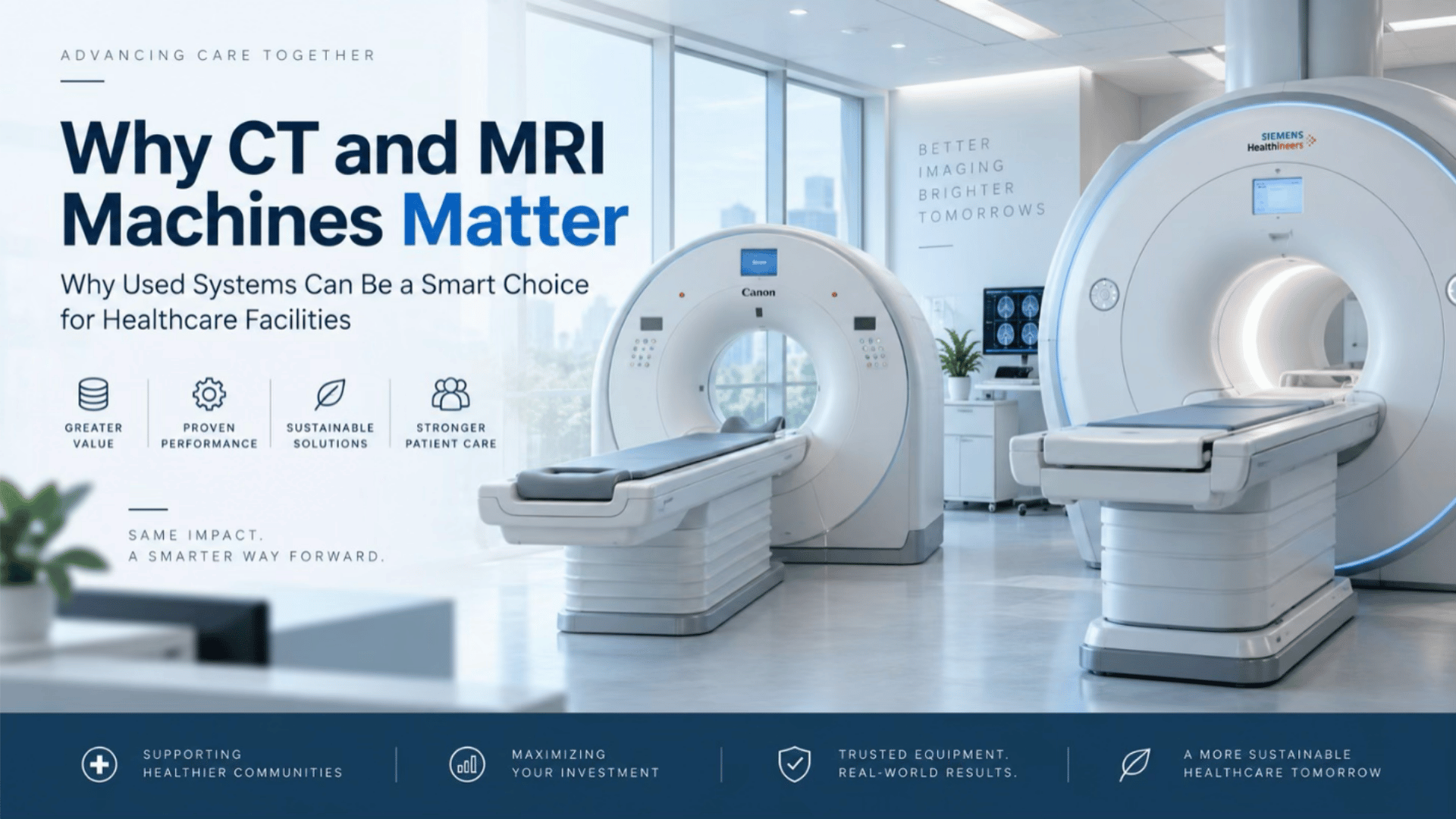
CT and MRI systems are among the most important diagnostic imaging technologies available to modern healthcare facilities.
Hospitals, outpatient imaging centers, orthopedic practices, specialty clinics, and other medical facilities rely on these systems to give physicians detailed information that often cannot be obtained through conventional X-ray imaging alone.
However, acquiring CT or MRI equipment can also represent a significant capital investment.
For many healthcare organizations, purchasing a properly evaluated pre-owned or refurbished CT or MRI system can provide access to advanced imaging capabilities without requiring the investment associated with purchasing the newest equipment available.
The key is understanding what the facility actually needs and evaluating the equipment based on clinical capability, condition, serviceability, installation requirements, and long-term operating costs.
Why CT Imaging Is So Important
Computed tomography, commonly referred to as CT, uses specialized X-ray equipment and computer processing to create cross-sectional images of the body.
Unlike a traditional X-ray that produces a two-dimensional image, a CT system can generate detailed “slices” of internal anatomy. According to the FDA, CT is used for diagnostic imaging, treatment planning, interventional procedures, screening in certain circumstances, and monitoring the effectiveness of treatments.
CT can be particularly valuable when physicians need detailed visualization of:
- Internal organs
- Bones
- Blood vessels
- Soft tissues
- Trauma
- Abnormalities
- Tumors and other disease processes
Its speed is another major advantage.
In emergency medicine, trauma care, oncology, cardiovascular imaging, and many other clinical environments, obtaining detailed diagnostic information quickly can be extremely important.
Because CT technology uses ionizing radiation, facilities must also maintain appropriate protocols, quality control procedures, and dose optimization practices.
Why MRI Machines Are Equally Important
Magnetic resonance imaging, or MRI, provides a different type of diagnostic capability.
MRI uses powerful magnetic fields and radiofrequency energy rather than ionizing radiation to create highly detailed images.
One of MRI’s major advantages is its ability to differentiate between different types of soft tissue. The FDA notes that MRI generally provides better soft-tissue contrast than CT and can distinguish between structures such as fat, water, muscle, and other soft tissues.
MRI is widely used for evaluating areas such as:
- Brain and neurological structures
- Spine
- Joints
- Muscles and tendons
- Abdominal organs
- Pelvic anatomy
- Cardiovascular structures
- Soft-tissue abnormalities
For orthopedic, neurological, musculoskeletal, oncology, and specialty imaging applications, MRI can be a critical diagnostic resource.
MRI systems also require specialized safety procedures because of their powerful magnetic fields. Facility design, equipment screening, implant screening, staff training, and MRI safety protocols must all be considered when operating an MRI department.
New Equipment Is Not the Only Option
When a facility decides it needs CT or MRI capability, one of the first questions is often whether to purchase new equipment or consider a used system.
The newest CT or MRI scanner may offer the latest software, reconstruction technologies, workflow improvements, and other advanced features.
But not every facility needs the newest generation of equipment.
A community imaging center, specialty practice, rural hospital, veterinary facility, or organization opening an additional imaging location may have very different requirements from a major academic medical center.
That is where pre-owned medical imaging equipment can become an attractive option.
Why Used CT and MRI Machines Can Make Financial Sense
The most obvious advantage of purchasing used imaging equipment is the potential reduction in acquisition cost.
CT and MRI systems are major capital purchases. Choosing a quality pre-owned system may allow a facility to preserve capital for other important investments, including staffing, construction, patient care technology, additional imaging modalities, or future expansion.
A lower acquisition cost can also make advanced imaging more accessible to smaller facilities.
Rather than delaying the addition of CT or MRI because of the cost of a brand-new system, an organization may be able to enter the market with a proven pre-owned platform that meets its clinical requirements.
The important consideration is not simply whether the equipment is new or used.
The better question is:
Does the system provide the clinical capabilities, image quality, reliability, service support, and workflow that the facility actually requires?
Proven Technology Can Still Deliver Significant Clinical Value
Medical imaging equipment does not automatically become clinically irrelevant when a newer model enters the market.
Many established CT and MRI platforms remain in service for years because they continue to meet the imaging requirements of the facilities using them.
The FDA itself recognizes that many medical devices are reusable and require preventive maintenance and repair throughout their useful lives. Proper servicing is critical to maintaining the safety and effectiveness of reusable medical equipment.
This distinction is important when evaluating pre-owned equipment.
A well-maintained system with appropriate service history, available parts, suitable software, proper installation, and continued technical support can be very different from simply purchasing an unknown used machine based on price alone.
What Facilities Should Evaluate Before Purchasing a Used CT Scanner
Not every used CT scanner represents the same value.
Facilities should evaluate the complete system rather than focusing exclusively on the purchase price.
Important considerations include:
Clinical requirements. Determine what examinations the facility plans to perform and whether the scanner’s configuration is appropriate for those applications.
Detector and system condition. The overall mechanical and electronic condition of the scanner should be evaluated.
X-ray tube condition. The CT tube can represent a significant component of operating and maintenance costs, making tube history and condition important considerations.
Software and reconstruction capabilities. Confirm that the system includes the applications required for the facility’s intended procedures.
Parts availability. Older equipment may become more expensive to maintain if replacement parts are difficult to obtain.
Service availability. Determine whether qualified service personnel can support the system in the facility’s geographic area.
Installation requirements. Electrical power, HVAC, shielding, room dimensions, equipment access, and site preparation can significantly affect the overall project cost.
Facilities pursuing CT accreditation should also understand applicable quality-control requirements. The American College of Radiology requires facilities participating in its CT accreditation program to perform quality-control testing and meet program requirements.
What Facilities Should Evaluate Before Purchasing a Used MRI System
MRI requires additional considerations because the scanner is only one component of a much larger installation.
Facilities should consider:
- Magnet strength
- Magnet condition
- Cryogen requirements
- Gradient performance
- RF coils
- Software applications
- Table and patient handling systems
- Chiller and cooling requirements
- Shielding
- Electrical requirements
- Parts availability
- Service support
- Room and site requirements
Coil availability can be particularly important because different anatomical examinations may require specific coils.
Facilities should also carefully evaluate whether an older MRI platform will continue to receive the service, software, and component support needed during the planned ownership period.
As with CT, organizations seeking ACR MRI accreditation must meet specific equipment, image-quality, quality-control, staffing, and operational requirements.
Used, Refurbished, Serviced and Remanufactured Are Not Always the Same Thing
Healthcare organizations should also understand the terminology surrounding previously owned medical equipment.
The FDA distinguishes between servicing and remanufacturing.
Servicing generally involves maintenance or repair intended to return a device to the safety and performance specifications established by the original manufacturer. Remanufacturing involves activities that significantly change the device’s performance, safety specifications, or intended use and can carry different regulatory requirements.
For buyers, this reinforces the importance of understanding exactly what has been done to a system before purchasing it.
Terms such as “used,” “pre-owned,” and “refurbished” should not replace proper technical due diligence.
Consider the Total Cost of Ownership
A lower purchase price does not necessarily mean a lower total cost.
Before selecting a CT or MRI machine, facilities should calculate the broader cost of ownership.
This may include:
- Equipment purchase
- Removal and transportation
- Site planning
- Rigging
- Construction
- Electrical work
- HVAC
- Shielding
- Installation
- Calibration
- Applications training
- Service agreements
- Replacement parts
- Software
- Preventive maintenance
- Future upgrades
A slightly more expensive pre-owned system with better parts availability and stronger service support may ultimately be a better investment than the least expensive unit available.
Matching the Equipment to the Facility Is What Matters Most
There is no single CT or MRI machine that is right for every healthcare organization.
A high-volume hospital performing advanced cardiovascular imaging may need capabilities that a smaller orthopedic or outpatient imaging center does not.
Likewise, a facility performing routine diagnostic examinations may not benefit financially from paying for advanced functionality that it rarely uses.
The most effective equipment strategy starts by evaluating the facility’s actual needs:
What studies will be performed?
How many patients will be scanned?
What level of image quality is required?
What applications are necessary?
What space is available?
What is the capital budget?
How long does the facility expect to operate the system?
What service resources are available locally?
Once those questions are answered, facilities can compare new and pre-owned systems based on value rather than simply age.
Used CT and MRI Equipment Can Be a Strategic Investment
CT and MRI technology plays an essential role in modern diagnostic medicine, but expanding imaging capabilities does not always require purchasing the newest scanner on the market.
For the right healthcare facility, a properly selected pre-owned CT or MRI system can offer a practical balance between clinical capability and financial responsibility.
The key is careful evaluation.
Facilities should consider equipment condition, clinical requirements, serviceability, parts support, software capabilities, installation requirements, regulatory considerations, and total cost of ownership before making a decision.
When those factors are properly evaluated, used medical imaging equipment can provide healthcare organizations with an effective way to expand diagnostic capabilities, replace aging systems, open additional locations, or make better use of available capital.
For facilities evaluating CT, MRI, or other diagnostic imaging equipment, working with an experienced medical imaging equipment provider can also help identify systems that match both clinical requirements and budget.