
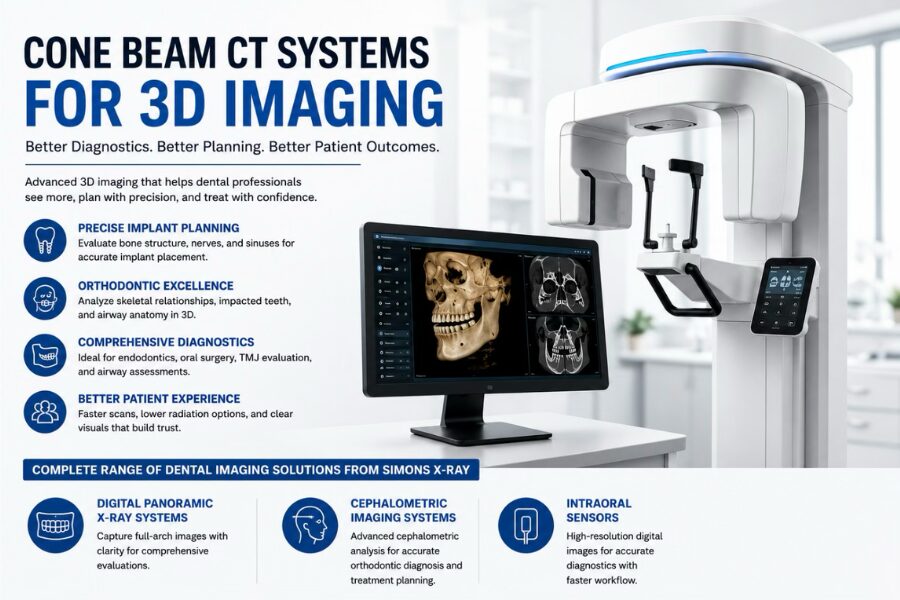
Dental imaging technology has evolved significantly over the past decade, allowing practitioners to diagnose conditions earlier, plan treatments more accurately, and provide patients with a higher standard of care. Among the most impactful innovations is Cone Beam Computed Tomography (CBCT), a technology that delivers detailed three-dimensional images of the oral and maxillofacial region.
For dental practices looking to expand diagnostic capabilities, improve implant workflows, and offer advanced treatment planning, a Cone Beam CT system can be a worthwhile investment. Simons X-Ray provides practices with access to modern CBCT technology along with a comprehensive portfolio of digital imaging solutions designed to support general dentists, specialists, oral surgeons, and orthodontists.
What Is a Cone Beam CT System?
A Cone Beam CT scanner is an advanced imaging device that rotates around the patient’s head while capturing hundreds of images from multiple angles. Specialized software reconstructs these images into a highly detailed 3D representation of the patient’s anatomy.
Unlike traditional medical CT scanners that use a fan-shaped beam, CBCT systems utilize a cone-shaped beam to acquire volumetric data in a single rotation. This method often reduces scan times and can expose patients to less radiation depending on the selected protocol and imaging requirements.
The resulting 3D images allow clinicians to visualize:
- Bone density
- Nerve pathways
- Sinus cavities
- Tooth roots
- Temporomandibular joints (TMJ)
- Airway structures
- Impacted teeth
- Implant sites
This additional information frequently leads to more confident diagnoses and better-informed treatment decisions.
Benefits of Cone Beam CT Imaging
Exceptional Image Quality
CBCT systems provide high-resolution images that reveal anatomical structures often hidden in conventional two-dimensional radiographs.
Clinicians can zoom, rotate, and evaluate structures from virtually any angle, improving diagnostic accuracy for complex cases.
Improved Implant Planning
Dental implants require precise positioning to maximize long-term success. CBCT imaging enables providers to measure bone volume, identify nerve locations, and determine ideal implant placement before surgery begins.
Advanced implant planning software can even facilitate guided surgery workflows, helping clinicians place implants with greater precision.
Better Orthodontic Assessments
Orthodontists can evaluate tooth eruption patterns, impacted teeth, jaw relationships, and airway anatomy using a single scan.
Three-dimensional imaging helps improve treatment planning and communication with patients and referring providers.
Faster Workflow Efficiency
Most modern CBCT systems complete scans in less than a minute.
This allows practices to:
- Reduce appointment times
- Increase patient throughput
- Minimize retakes
- Improve overall office productivity
Enhanced Patient Communication
Showing patients a detailed 3D image of their anatomy often increases case acceptance.
Patients can better understand treatment recommendations when they visually see the underlying condition.
Clinical Applications for Cone Beam CT Systems
CBCT imaging is commonly utilized for:
Dental Implant Planning
Evaluate available bone and determine implant positioning.
Endodontics
Identify root fractures, accessory canals, and periapical lesions.
Oral Surgery
Assess impacted wisdom teeth and proximity to vital structures.
Orthodontics
Analyze skeletal relationships and monitor treatment progress.
TMJ Evaluations
Examine joint morphology and degenerative changes.
ENT and Airway Studies
Evaluate airway restrictions and sinus anatomy.
Other Dental Imaging Products Available from Simons X-Ray
While Cone Beam CT technology is often considered the gold standard for advanced diagnostics, many dental practices benefit from having a complete imaging ecosystem.
Simons X-Ray offers additional dental imaging products to complement CBCT systems and support practices of all sizes.
Digital Panoramic X-Ray Systems
Panoramic imaging captures a broad view of the upper and lower jaws in a single image.
These systems are commonly used for:
- Wisdom tooth evaluations
- Orthodontic consultations
- Initial patient examinations
- Oral surgery assessments
Cephalometric Imaging Systems
Orthodontists frequently rely on cephalometric imaging to evaluate craniofacial relationships and monitor treatment progress.
Combining cephalometric capabilities with CBCT technology provides a versatile imaging platform for growing orthodontic practices.
Intraoral Sensors
Digital intraoral sensors offer immediate high-quality images while eliminating the need for traditional film processing.
Benefits include:
- Faster image acquisition
- Improved patient comfort
- Enhanced image clarity
- Reduced operating costs
Intraoral Cameras
Intraoral cameras help clinicians educate patients by displaying enlarged images of teeth and soft tissue conditions.
These tools can increase treatment acceptance by helping patients better understand their oral health concerns.
Phosphor Plate Systems
Practices transitioning from film-based radiography may find phosphor plate systems to be an affordable digital solution.
These systems maintain familiar workflows while providing digital image storage and sharing capabilities.
How to Choose the Right CBCT System
Before purchasing a Cone Beam CT scanner, dental professionals should evaluate several factors.
Field of View (FOV)
Smaller fields of view work well for endodontic procedures, while larger FOV options support implantology, oral surgery, and airway studies.
Software Features
Look for software that includes:
- Implant planning modules
- Airway analysis
- Nerve tracing
- TMJ evaluation tools
- DICOM compatibility
Space Requirements
Compact systems are available for practices with limited floor space.
Training and Service Support
Reliable technical support and training resources are critical when integrating advanced imaging equipment into a busy practice.
Working with an experienced imaging provider ensures practices receive assistance with installation, staff training, maintenance, and future upgrades.
Why Practices Partner with Simons X-Ray
Selecting an imaging system involves more than comparing specifications.
Dental providers often seek a trusted partner that can assist throughout the equipment lifecycle.
Simons X-Ray helps practices by offering:
- Consultation services
- Equipment recommendations
- Installation assistance
- Training resources
- Ongoing technical support
- Flexible financing options
Whether a practice is investing in its first digital imaging system or upgrading to a state-of-the-art CBCT platform, having knowledgeable guidance can simplify the purchasing process.
Final Thoughts
Cone Beam CT systems continue to redefine dental diagnostics by providing clinicians with detailed three-dimensional images that improve treatment planning and patient outcomes.
When combined with digital panoramic units, intraoral sensors, cephalometric imaging, and intraoral cameras, CBCT technology becomes part of a comprehensive imaging strategy capable of supporting nearly every aspect of modern dentistry.
Practices considering an upgrade should evaluate their clinical goals, patient volume, and future growth plans to determine which imaging solutions best align with their needs. Investing in advanced imaging technology today can position a dental practice for greater efficiency, improved diagnostics, and long-term success.